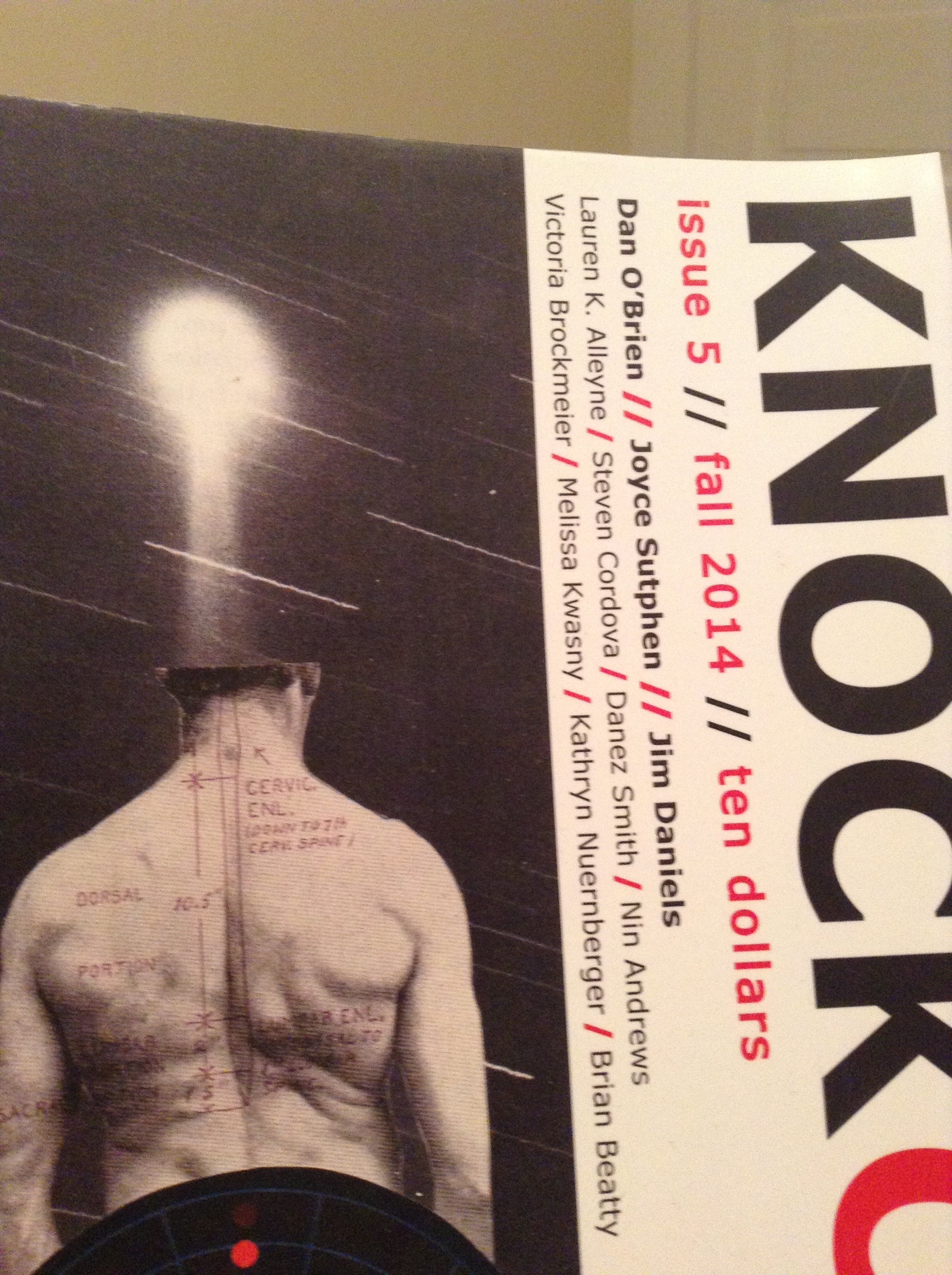
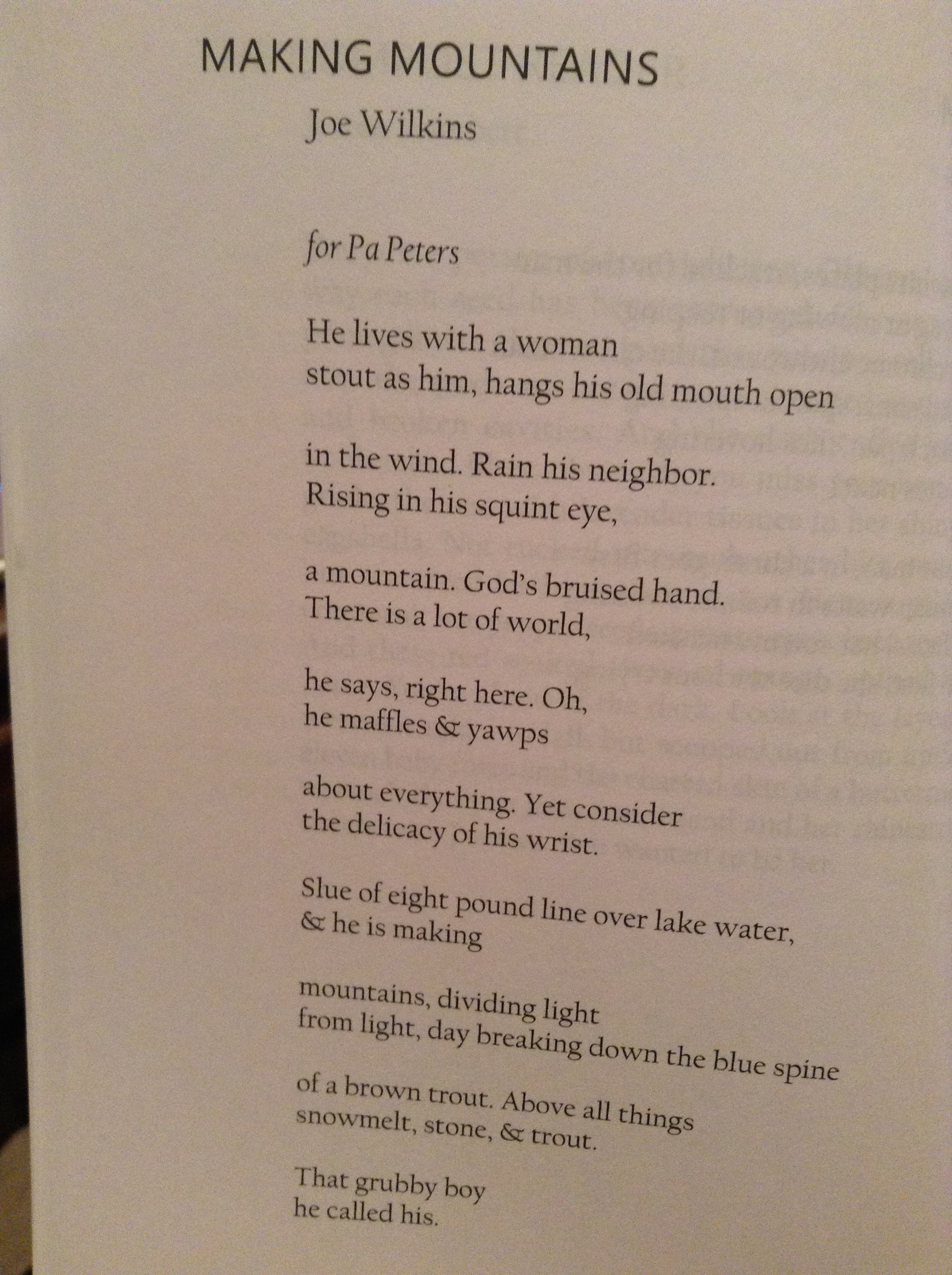
Pleased to have a poem in the current issue of Knockout, which features Melissa Kwasny, Jeffrey Alfier, Jim Daniels, Nin Andrews, and many others.
Pleased to have a poem in the current issue of Knockout, which features Melissa Kwasny, Jeffrey Alfier, Jim Daniels, Nin Andrews, and many others.

 The Spokane literary scene continues to amaze. Here’s another great anthology just out from Sage Hill Press, Railtown Almanac: A Spokane Poetry Anthology. Lots of wonderful poets included herein, including Christopher Howell, Jonathan Johnson, Shann Ray, Laura Reed, Nance Van Winckel, Jess Walter, and Maya Jewell Zeller, as well as my former teachers D.S. Butterworth, Beth Cooley, and Tod Marshall. Please to be part of it all.
 This fall I’ve been delighted to have two chapbooks released. First, from Red Bird Chapbooks, We Had to Go On Living: a collection of two essays, “Northern Pike” and “Bruised,” that both speak to the years my wife and I spent in the Midwest, years of joy, as we started our family, and loneliness, as we struggled to find our footing in new communities and alien landscapes. And just this past week, winner of the Iron Horse Chapbook Issue Competition, Leviathan: a short collection of poetry that also speaks to our Midwestern sojourn, though it does so in a host of voices and forms. And what beautiful books! Both presses took such care during the editorial and design processes. I’m so pleased to have had the chance to work with such wonderful folks and to now have in my hands these two lovely chapbooks.
 So pleased to be sharing the news of my latest collection of poetry, Leviathan, which won the 2014 Iron Horse Single-Author Contest. The chapbook will be out in just over two weeks, but you can pre-order now for just $4! You can get a sneak peek at the title poem here, and here’s what Carrie Jerrell, contest judge, and Laurie Kutchins, Pulitzer Prize finalist, have to say about the manuscript:
“Leviathan is a collection both celebratory and elegiac. Wilkins moves deftly from the natural landscapes of rivers and forests, to the domestic landscapes of garage sales and truck stops, to the emotional landscapes of terror and wonder brought on by fatherhood. He captures each of them in language and imagery as rich as the heart itself. Though the waters and people who populate these poems are often bracing, Wilkins never loses hope for long.” -Carrie Jerrell, author of After the Revival
“There’s alchemy in Joe Wilkins’s poems. Colic, junk, gutted factories, and rotten tomatoes become gold; castaway, castoff things at garage sales become luminous lists of all the things that keep us human. Some of these poems take us into birth-country; others, into the clutches of parenthood, into both literal and metaphorical floods. We think a chapbook is a little book, but no such thing with Leviathan. True to its title, this is a giant of a book with big-soul poems. This is no chamber quartet, but rather a full symphony of sonic energy and fierce, percussive love.” -Laurie Kutchins, Pulitzer-Prize finalist for The Night Path
 I’ve got a long poem, “Arguing with James Baldwin the Day After the Re-election of Barack Obama,” at a great new journal, Codex. Lots of strong work in this issue. Check it out.
 Just over ten years ago, back home for a holiday, I told my grandmother, an elderly widow living alone out on the plains of eastern Montana, that I planned to quit my good, exhausting job as a high school teacher and go back to grad school to get my MFA in poetry. My grandmother turned from the stove with a wooden spoon in her hand. She backed me up into the corner of kitchen, was all but whacking me in the chest. “Joe,” she said, spoon shivering in her fist, “thinking you can make a living as a writer is a temptation of the devil!”
Six months later, sitting at a conference table and staring at the small, pitiful poem in front of me, the poem that like all the rest had just been torn to metaphorical pieces in my first graduate workshop, I began to think it wasn’t making a living as a writer, but simply making it as a writer that was the true and fiendish temptation. In fact, if it had just been the writing, I would have left after that first, hard semester. But there was the reading, too. My literary education up to that point had been scattershot at best, but now—especially when it came to the literature of the American West—things were starting to come together. I read Kittredge for the first time that year, as well as B.H. Fairchild, Gretel Ehrlich, Mark Spragg, James Galvin, Dorianne Laux—and I dove into the work of my professors, too: Mary Clearman Blew, Kim Barnes, and Robert Wrigley. This, I remember thinking, is something my grandmother—who had books crammed into every nook and cranny of her house, who, when she gifted me her copy of the Montana anthology The Last Best Place, handed it to me as if the family Bible—would understand.
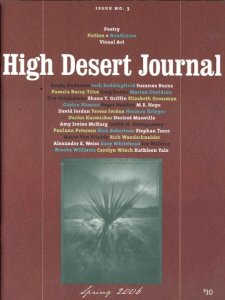
I discovered High Desert Journal that first year of graduate school as well. Here was a magazine after my own windburnt, high-plains heart: the first two issues featured, among other Western eminences, David James Duncan, Kathleen Dean Moore, Gary Snyder, Ursula K. Le Guin, William Kittredge, John Daniel, Kim Barnes, Robert Wrigley, Tami Haaland, Craig Lesley, and Kim Stafford. That spring, I wrote a story in a class with Mary Clearman Blew, “Far Enough: A Western in Fragments,” and I crossed my fingers and sent it off to High Desert Journal. They picked it up. It was my first prose publication ever, and the vote of confidence I needed to keep at it. I remember holding the issue, staring at the rust-red border, the black-and-white photo of a yucca beneath all the names—and there I was: next to Teresa Jordan and Paulann Petersen and Amy Irvine and Nance Van Winckel. I couldn’t hardly believe it.
For ten years now, High Desert Journal has been doing just this, publishing the luminaries of the West alongside the next generation of writers speaking from and about the American interior. As the nonfiction editor at HDJ, I’m pleased to be continuing this tradition, as well as searching for stories of the new and changing West. I’m hoping to find writing my grandmother would appreciate; writing that backs you up and makes you pay attention, writing that’s willing to say it like it is.
And I’m hoping you’ll join me by subscribing, here on our tenth anniversary, to High Desert Journal. In recent and forthcoming issues, you’ll find essays by Pam Houston and Kate Lebo, David Axelrod and Melissa Mylchreest, Shann Ray and Jon Rovner, Craig Childs and Sean Prentiss, Jill Talbot and Annie Lampman. You’ll find writing that will change the way you see and know the American West. Don’t miss out. Subscribe now.
I’m thinking of this one as my Midwestern: We Had to Go On Living, a limited-edition chapbook of two essays, “Northern Pike,” which originally appeared in the Harvard Review, and “Bruised,” originally appearing in The Sun, from our years in small-town Iowa. Thanks to Red Bird Chapbooks for their attention to these essays and for the beautifully designed chapbook.
 Started working on this poem over thirteen years ago. Been through hundreds of drafts–and here it is. Thanks to everyone at The Coachella Review for believing in it!
 My story, “Boys, Ten In All,” is featured in the August issue of The Sun. Pleased to see my work in such a fine venue.
 My poem “Ragged Point Road,” part of a series I’ve been working on, is up in the latest issue of the Nashville Review. Beyond great literary work, each issue of NR also comics and music and all sorts of cool stuff. Here’s a bit from their website:
Nashville Review was founded with two guiding principles: that our venue would be inclusive of all forms of storytelling, and that it would be both free and available online to anyone who wished to enjoy it. Thus, NRseeks to feature those forms of art not traditionally recognized as literature—comics, film, music, visual art, creative nonfiction, dance, oral storytelling and other performance arts—alongside the more traditional forms of fiction and poetry. We also feature interviews and a community section that showcases work from local writers. We publish three issues annually: on the 1st of April, August, and December. NR is published entirely online, and its readership includes visitors from over 100 countries.

