 I’m rather late with this, but my essay “My Mother’s Story, Retold and Annotated,” which won the 2010 Nonfiction Award, is up at the always beautifully-designed Briar Cliff Review.
News
Review up at Orion
 I’ve got another review, of Maureen N. McClane’s book of poems World Enough, up at Orion.
Two Poems in Poetry Northwest
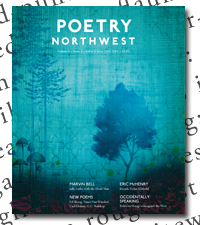 I’m delighted to have two poems, “On the Beginning of Winter in Some Lost Industrial City of the North River Country” and “Poem Thinning Out into Prayer,” in the latest issue of Poetry Northwest, the storied quarterly founded by, among others, Richard Hugo.
Poetry Northwest was founded as a quarterly, poetry-only journal in 1959 by Errol Pritchard, with Carolyn Kizer, Richard Hugo, and Nelson Bentley as co-editors. The first issue was 28 pages and included the work of Philip Larkin, James Wright, and William Stafford.
Poetry Northwest soon gained an international reputation for publishing some of the best poetry by established and up-and-coming poets in the U.S, Canada, Britain, and beyond, including such notables and award winners as Stanley Kunitz, Thom Gunn, Phillip Larkin, May Swenson, Theodore Roethke, Hayden Carruth, W.S. Merwin, John Berryman, Czeslaw Milosz, Philip Levine, and Anne Sexton.
In 1963, Poetry Northwest became a publication of the University of Washington. In 1964, Carolyn Kizer became the sole editor of the magazine, and held that post until 1966, when she resigned to become the Literature Director at the National Endowment for the Arts. David Wagoner then assumed the role of editor, a position he held for 36 years.
During Wagoner’s tenure, the magazine continued to publish established poets alongside new and emerging writers. Writers such as Harold Pinter, Joyce Carol Oates, Annie Dillard, Raymond Carver, James Welch, Ted Kooser, James Dickey, Robert Pinsky, Richard Wilbur, Wendell Berry, Charles Baxter, Mary Oliver, Edward Hirsch, Stanley Plumly, Linda Pastan, Stephen Dobyns, Stephen Dunn, Jorie Graham, Michael Harper, and Mark Strand were among the major contributors to its poetry-only pages.
In 2002, after several years of dire financial circumstances, Poetry Northwest — at the time one of the longest-running poetry-only publications in the country — temporarily ceased publication.
since 2005
In August 2005, the University of Washington appointed David Biespiel the new editor of Poetry Northwest, with an agreement that the editorial offices of the magazine would relocate to the Attic Writers’ Workshop in Portland, Oregon. The new series resumed publication in March 2006, in a larger, trade magazine format, appearing biannully as a print edition, with new monthly features published online. The magazine was incorporated as a 501(c)3 nonprofit in March 2007. Circulation quickly rebounded, surpassing pre-2000 levels as dedicated readers rediscovered an old favorite, and new readers enbraced the innovative new format.
In January 2010, the Board of Directors appointed Kevin Craft the fifth editor of Poetry Northwest. Craft returned the editorial offices to the greater Seattle area, reaching an agreement with Everett Community College to house and publish to magazine at Everett, where it will play in integral role in EvCC’s Written Arts AFA Program. Even so, Poetry Northwest remains an independent, autonomous nonprofit organization dependent on subscriber and community support.
According to Craft, “Our mission remains what it has been for more than five decades. In the words of founding editor Carolyn Kizer, ‘We shall continue to encourage the young and the inexperienced, the neglected mature, and the rough major talents and the fragile minor ones.’ We remain as committed as we were in 1959 to publishing the best poetry we can find, and to expanding the role and scope of poetry in ways both public and private, innovative and traditional, as an art and as a clear and necessary dialogue in a world overrun with noise.”
Pushcart Prize Special Mention
 I just learned that my essays “Out West,” originally published in Orion, and “You, All of You,” originally published in the Sun, both earned special mention in Pushcart Prize XXXIV: Best of the Small Presses.
Two Poems in Cave Wall #8
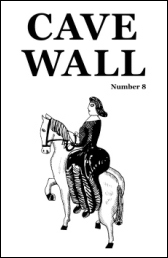 I have two poems in the most recent issue of Cave Wall, which also features wonderful new work by Robert Bly, Jillian Weise, and many others. Though Cave Wall is relatively new to the scene, editor Rhett Iseman Trull has really put together a wonderful magazine of verse.
Here’s a bit more from their website:
Cave Wall, published twice a year, is a national literary magazine dedicated to publishing the best in contemporary poetry. We are interested in poems of any length and style from both established
and emerging poets. Each issue includes black & white art, as well. Poems first published in Cave Wall have been featured on Poetry Daily, Verse Daily, The Writer’s Almanac, and in the Best New Poets awards anthology.What folks are saying about Cave Wall:
“In a community that is thriving with literary productivity, a fresh poetry journal has made its debut. Cave Wall…released its premier issue this winter to a flood of positive reaction and readership.”
–Jennie Thompson, Go Triad
“[Cave Wall‘s] goal is to offer poetic wonders. This first issue succeeds wildly.”
–Charles Wheeler, Greensboro’s News & Record
“Northern Pike” in the Harvard Review
 I’m delighted to see my essay “Northern Pike” in the most recent issue of Harvard Review. Here’s a bit about the review from their website:
In 1986 Stratis Haviaras, then Curator of the Woodberry Poetry Room of the Harvard College Library, founded a quarterly periodical called Erato. The purpose of this publication was to publicize the activities of the Poetry Room and create a new forum for discussion of current literary matters and events. The first issue of Erato, which was four pages long, featured a poem by Seamus Heaney, a short piece on Louis Simpson, and a news item from Harvard University Press. Tipped into the issue were three loose-leaf pages of book reviews, including reviews of works by Joseph Brodsky, Marguerite Duras, and Richard Ford.
Within three years the book review section had grown to over thirty pages and the publication was renamed Harvard Book Review. In 1992 Haviaras launched Harvard Review, a perfect-bound journal of over 200 pages, published semi-annually and incorporating the old Harvard Book Review. The purpose of the new journal was to foster the work of new writers, provide a forum for criticism of new literary works, and present the finest poetry and short fiction being written. In 2000 Haviaras retired from Harvard and Christina Thompson was appointed editor. At the same time, Houghton Library assumed administrative responsibility for the review.
In the nearly two decades since it was launched, Harvard Review has emerged as a major American literary journal with an eclectic mix of contributors in a wide variety of genres and styles. Contributors to the journal include: Arthur Miller, Joyce Carol Oates, Seamus Heaney, Jorie Graham, John Updike, John Ashbery, Alice Hoffman, and Gore Vidal, as well as those who are making their literary debut. Recent selections have been anthologized in: Best American Essays 2010, 2009, 2004, and 2003, Best American Poetry 2008, 2006, and 2002, Best American Short Stories 2005 and 2003, Best American Mystery Stories 2006, Best New Poets 2008, Pushcart Prize Anthology 2004 and 2001.
Memoir(and)
 My prize-winning poems “Anniversary” and “On Oblivion” are in the latest issue of the fascinating and beautifully-deisgned Memoir(and), which also features great work by, among others, Peter Levine and Rae Gouirand.
Alaska Quarterly Review
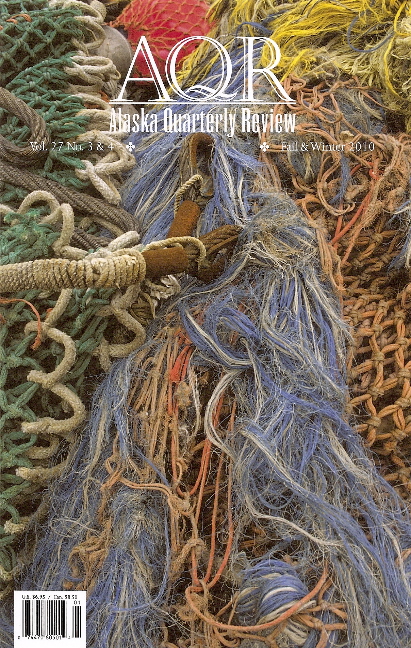
I’m truly delighted to have two poems in the current issue of Alaska Quarterly Review, which is, for my money, one of the best literary magazines in the country. Here’s more from their website:
“That one of the nation’s best literary magazines comes out of Alaska may seem surprising, but so it is.”–The Washington Post Book World
“Fresh treasure.”— The New York Times Book Review
“Alaska Quarterly Review is playing an impressive part in our national literature. Congratulations on publishing such wonderful stories.”–Laura Furman, Series Editor O. Henry Prize Stories
“AQR is highly recommended and deserves applause.”— Bill Katz, Library Journal
“The magazine has a wonderful sense of place about it, and it conveys Alaska without being parochial. It’s not pushing a particular agenda. There’s no coterie of writers made up of the editor’s friends. The work is original and fresh.”— Stuart Dybek, Contributing Editor
“When all is said and done, Ronald Spatz and his crack team of editors put together one hell of a magazine. Read it cover to cover; put it on your coffee table; impress your friends. This magazine’s so hot, it makes any number of editors in the lower-48 look like they’re living in the ice age.”—John McNally
Literary Magazine Review
“…Among the top literary journals in America… Alaska Quarterly Review is holding its creative course and staying true to its original vision of promoting new writers and giving a home to fresh voices on the writing scene. …This is storytelling at its finest.”–Phoebe Kate Foster, PopMatters Associate Books Editor
“A national presence.”–Patricia Hampl, Contributing Editor
“Good fiction shows us the inside of things–a community, a job, a relationship, the human heart. Great fiction can sometimes show all of these things working together; it lifts us briefly above the event horizon of our own day-to-day existences and gives us a dreamlike (and godlike) sense of understanding what life itself is about. Cary Holladay’s “Merry-Go-Sorry” is one of those rare and always welcome stories.” —Stephen King, Prize Jury, O. Henry Prize Stories,“Adding to the poetry, fiction, and essays that the Alaska Quarterly Review has been publishing for twenty-three years, at the University of Alaska, Anchorage, the Fall/Winter issue of the journal, edited by Ronald Spatz, includes an eighty-page photo essay (eighty pages!) that is unique in both content and scope. In “Chechnya: A Decade of War,” photojournalist Heidi Bradner documents the Chechen Republic’s decade-long battle for independence from Russia. An image of Russian soldiers searching a mass grave in Grozny is balanced by the image of a family returning to the shattered remains of their home in a Chechen village. The feature includes photographs from both sides of what Brander calls “Europe’s longest-running but least visible war.” —Kevin Larimer, Senior Editor, Poets & Writers Magazine
“AQR is an impressive publication, comprising as diverse and rewarding an aggregation of work as a reader is likely to find in any literary journal.” — Patrick Parks, Literary Magazine Review
“Alaska Quarterly Review is one of the top ten literary magazines in the country.” — Sherman Alexie
PEN Center USA Finalist
 Just this week my essay “Out West,” originally published in Orion, was named a finalist for the 2010 PEN Center USA Award in Journalism. PEN is a great organization, and this is wonderful, humbling news.
PEN Center USA’s annual awards program, established in 1982, is a unique, regional competition that recognizes literary excellence in ten categories: fiction, creative nonfiction, research nonfiction, poetry, children’s literature, translation, journalism, drama, teleplay, and screenplay. Past award winners include Barbara Kingsolver, Maxine Hong Kingston, T.C. Boyle and Paul Thomas Anderson. Each fall, PEN USA calls for submissions of work produced or published in that calendar year by writers living west of the Mississippi River. Entries in the ten categories are reviewed and judged by panels of distinguished writers, critics and editors. Winners are announced in late summer. Each receives a $1,000 cash prize and an invitation to the Annual Literary Awards Festival in Los Angeles.
The Literary Awards Festival includes a dinner, the presentation of the literary awards and honoree awards, and a silent auction or raffle. This gala is the only one of its scope on the West Coast and is attended by more than 500 prominent members of the literary community. Past recipients of the Award of Honor and Lifetime Achievement Award include: Ray Bradbury, Betty Friedan, Gore Vidal, Carolyn See, and Billy Wilder. The evening concludes with the presentation of the prestigious Freedom to Write Award, given to men and women who have produced exceptional work in the face of extreme adversity, who have been punished for exercising their freedom of expression or who have fought against censorship and defended the right to publish freely.
Willow Springs
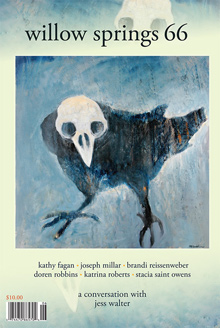 I’ve long admired Willow Springs, the literary magazine out of Eastern Washington University’s MFA program, and am jazzed to see my poem “Theodicy Envoy” in the latest issue. Here’s a bit from Willow Springs’ website:
Willow Springs publishes the finest in contemporary fiction, nonfiction, and poetry, as well as interviews with some of the most notable authors in contemporary literature, including Marilynne Robinson, Stuart Dybek, Aimee Bender, and Robert Bly. Founded in 1977 and published twice yearly, Willow Springs features two interviews per issue, as well as arresting essays, fiction, and poetry by a diverse variety of writers—from the unknown and up and coming, to U.S. Poet Laureates and Pulitzer Prize winners. An indispensable resource for writers and readers, Willow Springs engages its audience in an ongoing discussion of art, ideas, and what it means to be human.
In our 30 years of publication, Willow Springs has looked for and published fresh and established voices in fiction, poetry, and nonfiction, including those of Tobias Wolff, Jorge Luis Borges, Yusef Komunyakaa, Louis Jenkins, Denise Levertov, James Grabill, WS Merwin, William Stafford, Charles Bukowski, Chris Offutt, Robert Olmstead, Michael Martone, Robert Hass, Michael Heffernan, Tomaž Šalamun, Bret Lott, Sam Hamill, Naomi Shihab Nye, Alice Derry, Paulann Peterson, Osip Mandelstam, Patricia Henley, Thomas Reiter, Bill Tremblay, Tom Crawford, Mark Halliday, D. Nurkse, Elizabeth Murawski, and hundreds of others from around the world.
 joewilkins.org