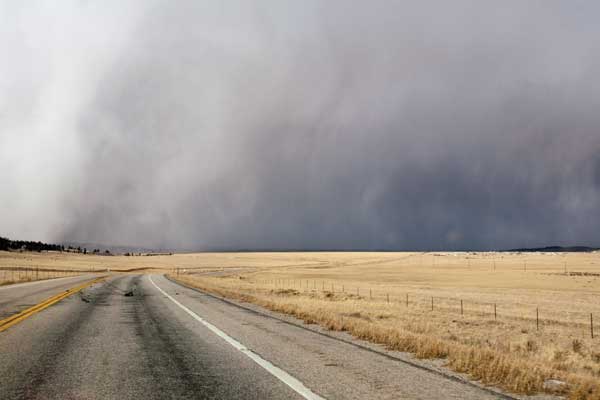
 Just saw that my story “Say,” which originally appeared in The Sun Magazine and was reprinted in The Utne Reader, is now up at Utne’s website. I had fun with this one.
News
Reading at Linfield College
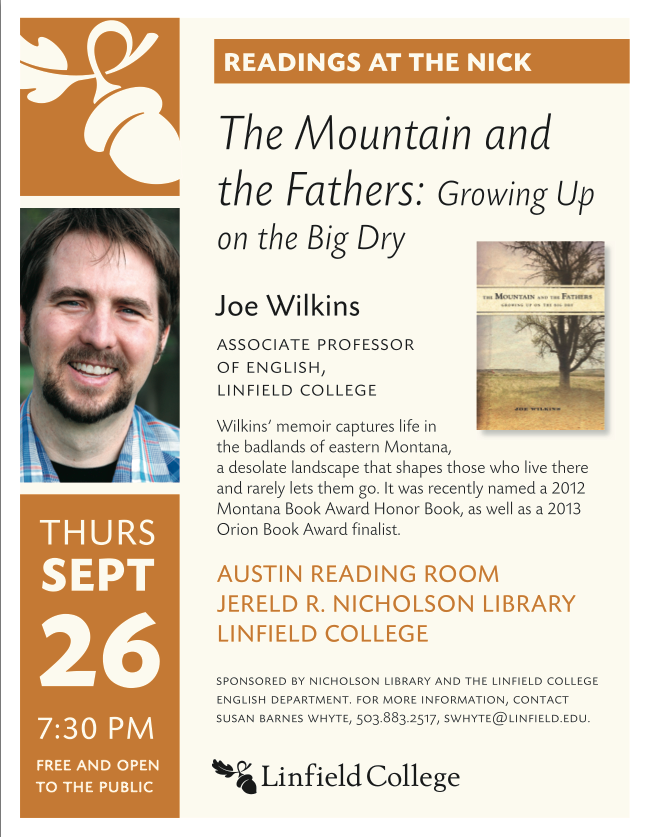 Very pleased to be opening Linfield College’s Readings at the Nick Series this year! I’ll be up at the mic on Thursday, September 26, at 7:30 pm, and we’ve got lots of great folks coming this year, including Monica Drake, Peter Malae, Elena Passarello, and Chris Dombrowski!
Poem in Orion
 My poem “Drought” appears in the latest issue of Orion. Lots of wonderful stuff in this issue (as always–Orion’s plain great!), including a stunning/scary essay on the breast cancer industrial complex by Jennifer Lunden and a dreamy meditation on borders, dying rivers, and ghosts by Luis Alberto Urrea.
Review of Notes from the Journey Westward
Thanks to Kathleen Kirk for this amazing review, up now at Escape Into Life, of my second book of poems, Notes from the Journey Westward. A few of my favorite lines:
Notes from the Journey Westward, by Joe Wilkins, reads like wisdom to me. “There’s nothing to be done / about hope,” he writes, in “Hardscrabble Prairie Triptych,” about cracking open mussel shells in search of pearls, and I feel directly addressed, required to examine the persistence and hopelessness of hope in myself, in us all, in the human animal: “We crack them open / anyway, shells bright as a boy’s eyes, / scoop out each stinking handful of meat.” The willingness to shift from “I” to “we” here is a clue to the risk and power of these poems, the great claim that one story can, like a covered wagon, carry many, and that history is somehow alive in the present moment.
“Out West” Reprinted in Draft: The Journal of Process
 My essay “Out West” is reprinted in the current issue of Draft: The Journal of Process. But here’s the cool part: everything in Draft–along with my essay, there’s a poem by Matt Hart and a story by Roxanne Gary–is printed alongside an early version of the same piece, so you get to see behind the finished object. You get a glimpse of the process.
The issue also features an interview I did with one of the editors, the amazing Rachel Yoder, as well as a poem that came out of the drafting of “Out West.”
Read This – Robert Wrigley’s Beautiful Country
 The other weekend, on a plane from Denver to Minneapolis, my sixteen-month-old son sleeping fitfully on my lap, I reread Robert Wrigley’s Beautiful Country and felt like some kind of thief, keeping all these breathless, needful, gainsaying poems to myself. I wanted to whisper into the small hollow of my son’s ear, recite to my wife, turn in my seat and to the man in the blue suit behind me say, “Listen.”
Consider “Finding a Bible in an Abandoned Cabin,” a short, unassuming lyric near the middle of the book, in which the speaker simply tells of how he lifted the old leather cover and “the book / opened like a blasted bird,” how there were no more “familiar and miraculous inks,” only “a constructions of filaments and dust, / thoroughfares of worms, and a silage / of silverfish husks.” Though these lines can no doubt be read as a succinct critique of one of our deepest, most pernicious national obsessions, what I find so powerful about the poem is that it wrecks us and reconstructs us. The end takes us one step further: “in the autumn light, / eight hundred pages of perfect wordless lace.” In place of Paul’s fearful exhortations and those miracles that work against the natural world, Wrigley gives us the rot of silverfish, autumn light, and lace. He allows us, for a moment, to be in and of the world.
The poem, like so many in the book, is technically dazzling as well: dense, sound driven, syntactically various. Truly, Wrigley is the rare poet who delights and challenges the intellect, while instructing the heart. And there is no better example of this than the very next poem in the book, “Exxon”: a three-page, moment-exploding tour de force about shaking a wounded Iraq War vet’s hand at a gas station. Here, rather than letting the images themselves allude to the cultural forces surrounding a particular moment, Wrigley names them all. Searching after some kind of meaning, he lets his language spin out and away and grab hold of everything from prosthetic supply catalogs and the Book of Job to IED’s, our gasoline fueled capitalism, and definitions of citizenship. Yet Wrigley again refuses to merely deconstruct, refuses to let us let go that vet’s hand. Like the war itself, the poem inexorably marches on and into all our lives:
See the soldier who nods and whose left
intact hand extended to your extended right one
confuses you an instant, but who nods again
to relieve you in your awkwardness. And behold them,
your untouched touched hands, as he nestles his man-made
right one over both of yours on his left, feeling,
between his old self and his new, a responsible citizen.
Many of the poems in Beautiful Country follow these patterns. Like “Finding a Bible in an Abandoned Cabin,” “Lichen,” “Misunderstanding,” and “Hailstorm in the Mountains” are all carefully crafted lyrics, while “County,” “American Fear,” and “Do Not Go” are similar to “Exxon” for their torqued language and sheer ferocity. Yet Wrigley has always been a powerful narrative poet as well. While never leaving that songlike language, with poems like “Responsibility,” “Letting Go,” and “Beautiful Country” Wrigley allows the poems to loosen up as he tells us of weekend pack trips with his sons and days spent stemming pot as a conscientious objector during the Vietnam War. Perhaps my favorite poem in the book, “Miss June, 1971,” has Wrigley again remembering his CO days, facing down an angry sergeant major and a Playboy calendar on the wall behind him:
I was not a Protestant then and did not protest
the sergeant major’s treatment of me. Instead, I took it
and didn’t say a word but studied
the bit of parsley between his teeth, August 1971,
and, for many years thereafter, understood nothing.
Almost all the poems in Beautiful Country are sharper, angrier, more culturally concerned than those of Wrigley’s last few books, yet readers will find Wrigley still grappling with many of his usual subjects: horses, mountains, starlight, the wind in the cedars. For this strange but effective admixture, Beautiful Country calls to mind two of Wrigley’s earlier masterworks: The Lives of the Animals, a book deeply rooted in the mountains of Idaho, and What My Father Believed, which chronicles Wrigley’s refusal to fight in the Vietnam War and his relationship with his father. Beautiful Country is also, simply, a great book by one of our great poets.
Though I missed the man in the blue suit, I have already given Beautiful Country over to my wife. Someday, when he is wondering at this maddening, breathtaking country of ours, I will hand it to my son.
This review originally appeared in the March/April 2011 issue of Orion magazine.
Poem at Poetry Daily
 Earlier this week, my poem “Then I Packed You Up the Ridge Like a Brother on My Back,” from Notes from the Journey Westward, was featured at Poetry Daily.
Talking Writing and Nature with Pam Houston

As part of Scott Temple’s Wyld-Er-Ness documentary series, Pam Houston and I sat down on a snowy spring day in Boston and talked writing and nature. You can find the newly released video at Orion Magazine’s blog.
Review of Notes from the Journey Westward
 A big thanks to Mark Allen Jenkins and Stirring for this insightful, kind review of Notes from the Journey Westward!
Read This – Gregory Martin’s Stories for Boys
Read This – Gregory Martin’s Stories for Boys: A Memoir
As a teacher of creative nonfiction writing, I spend a good portion of my time trying to convince my students that the best memoirs and personals essays are never about what happened—but about what the author makes of what happened.
This, I would like them to understand, matters a great deal, as it then opens up for exploration all the mundane, pedestrian, and, to use a word they often us, “normal” parts of our lives. Took a walk across town the other day? Called your older sister for the first time in a few months? Remembered, for some reason, that big camping trip your family took when you were seven? Write about it. There is a richness there; something you, and the reader, might discover.
The converse of this axiom, of course, is that if you do happen to lead a particularly fascinating life or have gone through something terrifying or wild, you still can’t ride on just what happened. You have to try, no matter how particular or terrifying the story, to make some kind of sense of it all.
Which is why I so admire Gregory Martin’s new memoir Stories for Boys. Consider the sequence of events: Martin gets a call from his mother: his father has just tried to commit suicide. Later, talking with his father in the hospital, Martin finds out two things: 1) that his father was molested as a boy by his own father and 2) that his father is gay and for most of his adult life has been having anonymous affairs with men at rest stops and in parks. Martin’s parents subsequently divorce, Martin struggles to support and understand both his parents during this process, and Martin’s father then moves across the country and attempts to begin another life. Whew.
But here’s what’s so admirable, so affecting: Martin lays out these plots points just about as fast as I have right here, and then he gets down to the real work—trying to make a story of all this that he might believe in and be able to share with his own young sons.
The story in Gregory Martin’s Stories for Boys is the making of the story. Using photographs; email transcripts; psychological research; Walt Whitman anecdotes; treehouse blueprints; careful, restrained scenes; and good-old-fashioned thought on the page, Martin details his years-long search for a way to make of all that has happened a new story, a truer story, a story that he, his sons, and his father can live with. And in the process he has written a beautiful, truth-full, hope-filled memoir.
 joewilkins.org