The Iowa Review just posted this wise, wide-ranging review-essay on the literature of the American West, with a special focus on my work, including Far Enough, The Mountain and the Fathers, and Killing the Murnion Dogs.
The Iowa Review just posted this wise, wide-ranging review-essay on the literature of the American West, with a special focus on my work, including Far Enough, The Mountain and the Fathers, and Killing the Murnion Dogs.
 Last time I had a chance to hang out with Sy and everyone at The Sun Magazine, they let me know they’d voted me “Sun Contributor Most Likely to Own a Pickup.” Smart folks. Sure excited to get a chance to join them in Big Sur this weekend as part of the faculty at Into the Fire: The Sun Celebrates Personal Writing.
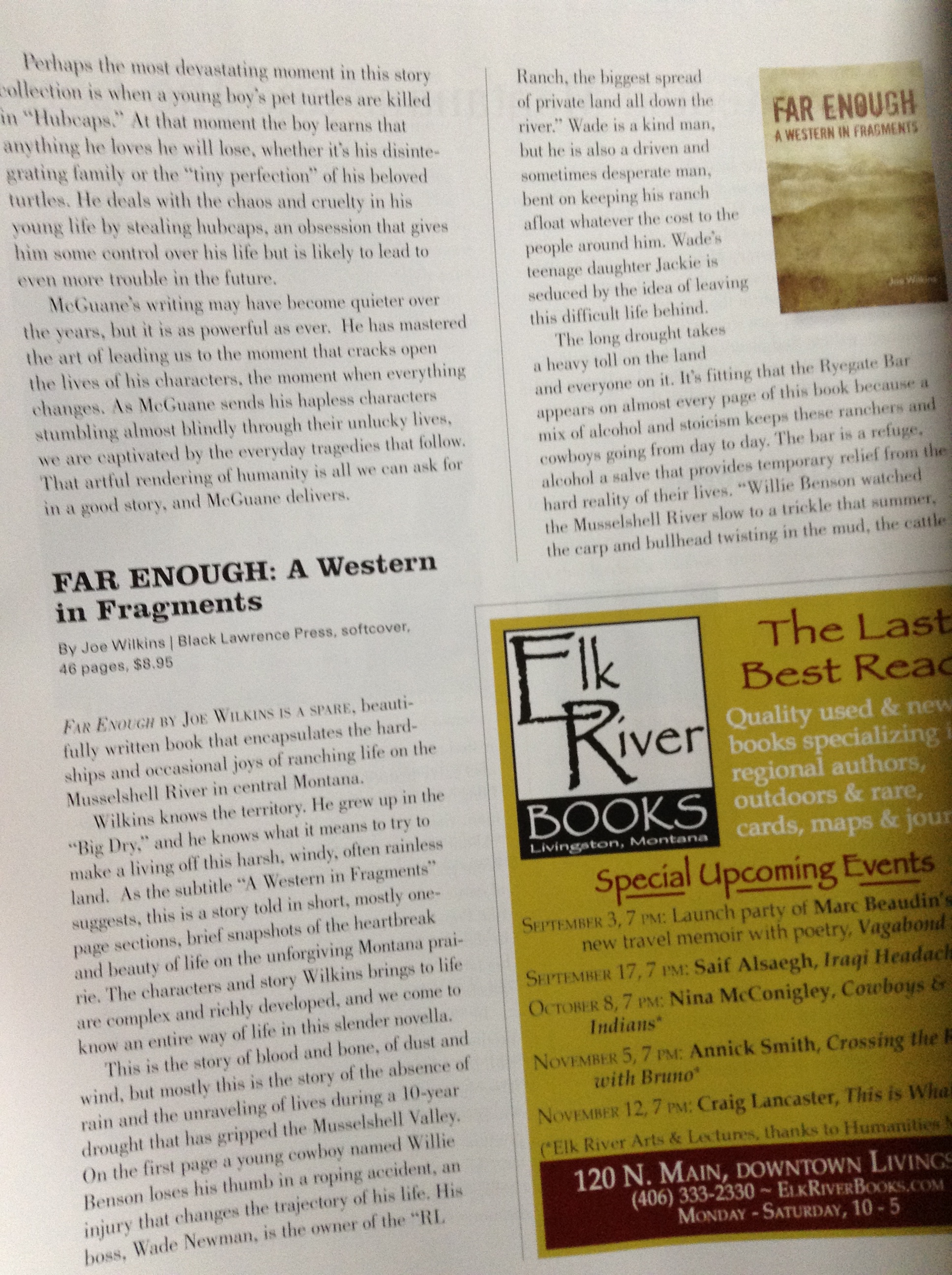 A big thanks to Scott McMillion, Craig Lancaster, and, especially, Elise Atchison for a wonderful review of Far Enough in The Montana Quarterly. And it feels pretty good to be following Tom McGuane in the book review section as well!
Here’s a bit from the end of the review:
Wilkins writes about rural Montana with the same brilliance and precision as Ivan Doig or Wallace Stegner. His lyrical descriptions and evocative imagery make for a jaw-droppingly beautiful book. There is a mysterious alchemy that takes place when beautiful language is mixed with the dust and blood of hardscrabble lives. In Far Enough we are left with pure gold.
 Thanks to Vivian Wagner and Easy Street: A Magazine of Books and Culture for this free-wheeling, thoughtful review of Far Enough! Here’s my favorite bit:
This book shows how a book can be woven out of shards that have been chiseled off the heartstone of the West and assembled in such a way as to make sense, to tell a story. It’s a postmodern western, but it’s a western nonetheless. While I read the book on a hot summer day, sitting in my hammock here in a village at the Appalachian edge of the Midwest, I started thinking of Mark Twain and Richard Brautigan, of Sherman Alexie and Louise Erdrich, of all those strong regional voices that capture the spirit of various frontiers. This is the spirit of Wilkins’s book. He brings to life through fragments a time and a place, a contemporary West in which mothers die not from bear attacks but from meth overdoses, a world in which the river runs dry every summer, possibly the action of an angry god, but more plausibly because of climate change. And it’s able to tell these stories through brief snippets, paragraphs, and one- to two-page pieces linked only by a shared vision of the world they create.
Had a wonderful time at the Jackson Hole Writers Conference this last weekend. Met some great writers and got to read loads of wonderful writing by energized, engaged folks. A special thanks to Laurie Kutchins and Tim Sandlin for the invitation.
And I finally got my hands on Far Enough! Here’s a shot from the book sale on the last day of the conference:

 With Far Enough: A Western in Fragments on the way, it seems like a good time to revisit this film review, “American Myth-Busting” (originally published in Orion Magazine), in which I take on the pernicious myths of the traditional Western and argue for the harder truths of the Neo-Western.
American Myth-Busting
Growing up on the plains of eastern Montana, I saw my fair share of Westerns. We didn’t have a VCR when I was a boy, and my mother didn’t allow us to watch much TV, but Westerns were just part of the general atmosphere. The bachelor farmer who lived across the river played videocassette after videocassette when he babysat my brother and me. We watched them at school, on holidays or when we had substitutes. I have to say, though, I never much liked Westerns. They didn’t fit what I saw in the Western world around me. Though my mother was a widow raising three children, she didn’t need rescue; she did fine on her own. My grandfather, who quit school after the eighth grade to cowboy for a living, wasn’t a man of brooding violence and righteousness; he was gentle and fun and inquisitive.
I’m not the first to level this argument against the mass-market Western. In 1902 the novelist and critic Frank Norris announced:
The frontier has disappeared. . . . But when at last one comes to look for the literature that sprang from and has grown up around the last great epic event in the history of civilization, the event which in spite of stupendous difficulties was consummated more swiftly, more completely, more satisfactorily than any like event since the westward migration began—what has this produced in the way of literature? The dime novel! The dime novel and nothing else.
Though the celebratory tone galls, though I take strong issue with (among other things) the phrase “more satisfactorily,” and though I’m reading these words 110 years later, years which have seen the likes of Willa Cather, Wallace Stegner, James Welch, and others author epic, necessary, and honest works of literature about the American West—when it comes to film, I still find myself mostly agreeing with Norris. And this is a problem.
Movies matter, deeply, in America, and the simple dishonesties of those dime books, writ large on silver screens across the nation, built into the guiding visions and imaginations of boys and girls from Tennessee to Montana, have shaped a number of our most insidious American mythologies. Though it could be argued that neither Stagecoach nor Shane holds much sway in our contemporary psyche, consider instead Rambo, or the latest iteration of Die Hard, or even The Hurt Locker—really any big screen affair featuring an honorable, lonely, decidedly masculine hero staring down the bad guys. Truly, many of the shoot’em up blockbusters we see each summer are direct mythological descendants of those dime-novel Westerns, which posited, among other things, that with right intention violence will lead to stability and community; that the present situation is somehow degraded or dishonest and only our hero—violent and brooding but honest to a fault—will serve as tonic and example; and that we might deeply love the natural world while still destroying or vastly altering large tracts of it. And from President Bush’s cowboy foreign policy to local proponents of fracking, you see the problem. Stories have power. Despite all evidence to the contrary, we’ll cling to whatever myth made us. Even as the water slips over our noses, we’ll keep filling our pockets with those same stones.
We need newer, truer stories. We especially need stories that take a wrecking ball to those used-up, dead-wrong myths, which is why I find the recent run of neo-Westerns—Smoke Signals, Brokeback Mountain, Down in the Valley, The Three Burials of Melquiades Estrada, There Will Be Blood, and No Country for Old Men, among others—so heartening.
Yes, I know. It’s hard to think of the Coen brothers’ bloody, disturbing adaption of Cormac McCarthy’s novel (which is even more bloody and disturbing) and think heartening. Yet I would argue there is different violence present here. The blockbuster, and the dime novel before it, would have us believe violence can be directed and controlled, used. When employed by the good guy, violence becomes a tool for community, justice, and righteousness. This, I think, is stunningly naive. Violence is always more than a tool. It is a force beyond the wielder of it, a force that leads mostly unto itself. So Llewellyn Moss steps, even briefly, and despite his self-serving but understandable intentions, into the brutal world of the cross-border drug war and is irrevocably sucked (along with his blameless wife) into a sudden, short life of violence. Even Anton Chigurh, who seems for the bulk of the film demonically in control, is literally blindsided by violence at the end, when a speeding car slams into him at an intersection. As Chigurh stumbles from his vehicle, a broken bone spurred through the meat of his forearm, a young boy, witness to the crash, keeps repeating, “Would you look at that fucking bone!” That is violence. Startling, amoral, beyond us all. Even the devil himself is wrought up in it, is ruined by it.
Violence works against the very land we make so much of as well. The many landscapes of the American West may be fussed and fawned over in the Western, but those landscapes are also settled, plowed, grazed, fenced, mined, dug for roads and ditches, and, in a word, destructed. Without a doubt, the true loser of most every traditional Western is the land. And here, again, these new Westerns are far more honest in their portrayal of this sad history: the landscapes of the American Southwest are oil-stained and smoking in Paul Thomas Anderson’s There Will Be Blood, and in David Jacobson’s Down in the Valley we get any number of long, heat-warped shots not of high plains and mountains—but of six-lane superhighways, dry aqueducts, and metastasizing housing developments.
Beyond adherence to violence as a corrective and solution, nothing characterizes the traditional Western more than the elemental honesty of the hero. The Western hero is a truth-teller—honest as the day is long, honest as the horse between his knees—and even if our hero’s truth forces him to stand outside law or society, we know, always, that wherever he stands, he’s right (I think here of the run up to the Iraq War, and how listening to Bush and Rumsfeld on the news, I sometimes found myself almost convinced that a preemptive war made sense). So, it seems to me right and fitting that if there is one thing that defines these new Westerns, it is their fidelity to dishonesty. Time and again in these films, we witness characters reckoning with the falsehoods and subtleties that turn in the wind around them, all while being battered by the half-seen hopes and misunderstood desires hidden in their own hearts. In Chris Eyre’s Smoke Signals Arnold Joseph hides, for years, a monstrous secret that eventually drives him from his family and nearly kills his son; Jack Twist and Ennis del Mar of Ang Lee’s Brokeback Mountain must conceal their love and who they are from wives, children, and the entire brutal human world they’ve been born into.
Yet nowhere is this wrestling with what is true and what is false more apparent than in Tommy Lee Jones’s masterful The Three Burials of Melquiades Estrada, a decidedly Western film, featuring every traditional trope from sunset shots of Texas scrublands to a cast of characters that includes a no-nonsense sheriff, a neglected wife, and a kind cowboy. Yet The Three Burials of Melquiades Estrada is also very aware of the territory it’s covering. The characters might aspire to the myths they’ve been reared on, but they soon discover that those stories just plain don’t work: Our hero, Pete, convinces himself that since the law won’t go after the Border Patrol agent who accidentally killed his friend and fellow cowhand, Melquiades Estrada, it is his Western duty to do just that. He kidnaps the agent and on a long trip down into Mexico brutally tortures him. But that’s not even the half of it. The force of Pete’s grief is so strong that the viewer is caught up in this violence as well. It seems that Pete’s vigilantism might be exactly what’s needed to deal with this dishonest, racist world. Not so.
Near the end of the film, confronted with irrefutable evidence of Melquiades’s dishonesty—evidence that calls into question every brutal, illegal, loyal thing Pete has done—Pete simply won’t accept it. His delusional adherence to myth is too strong. Instead, he tries to remake the world, forcing Melquiades’s killer to rebuild a ruined village, bury Melquiades’s rotting body for a final time, and beg forgiveness of Melquiades’s ghost. And, in a wonderful twist, this elaborate ritual does seem to absolve the killer—which of course destroys the story Pete’s been telling himself all the further. With the bad guy redeemed, who’s the good guy? Which side is which? You see, in this Western it’s not that the world has changed or that we have forgotten what things mean—it’s that we never really knew this world at all. Our stories obscured the truth; our stories have ridden us to our ruin.
Yet—and this is important—from start to finish, The Three Burials of Melquiades Estrada is a downright beautiful movie. The landscapes of south Texas and Mexico are wide and wild and lovely, and even after his lies are made plain, we see that Melquiades spoke the truth about one thing, the country of his youth: “If you got to Jimenez,” he tells Pete, “I swear to you your heart will break with so much beauty.” Despite the violence that’s been done to the land, these new Westerns honor the land’s rough beauty and renewing power and so manage a kind of hopeful condemnation. Consider the last scene of Smoke Signals, where we enter Thomas Builds-the-Fire’s mind’s eye, and see there the Spokane River as it snakes through mountain meadows and thunders toward a rock-strewn falls. “How do we forgive our fathers?” Thomas asks. “Do we forgive our fathers in our age, or in theirs? If we forgive our fathers, what is left?” We, the viewers, are left with the river. Whether we forgive our fathers or not, a river is something beyond us. There is a cautious hope in this: For all our blunders in the West, this river still runs.
There are no easy, dime-novel answers in any of these new Westerns. And so, I think, we finally have the beginnings of a silver-screen legacy worthy of the epic-but-troubling history Norris cites: We have questions. And as we wind down our war of aggression in Iraq, as we listen to the claims and promises of another presidential campaign, as we watch our extractive technologies continue to outpace our knowledge of the ramifications of those technologies—we should be asking lots of questions. Questions that continue to bust up those most pernicious myths, questions that will force us to take a good, hard look at ourselves and the reality of the American West.
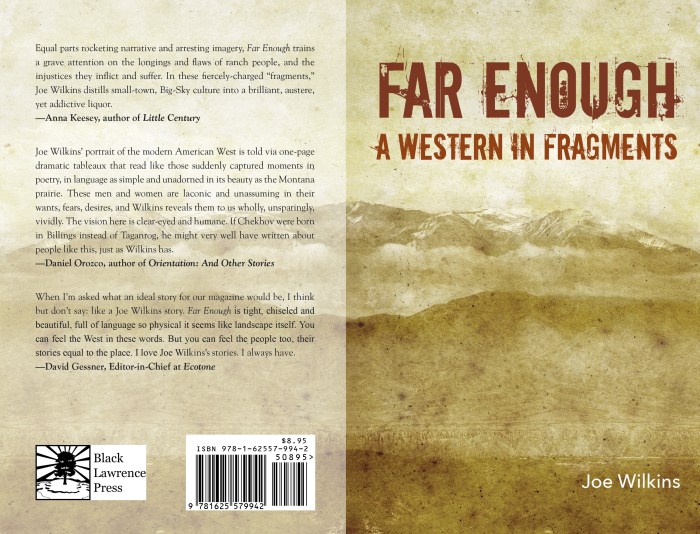
Pleased as can be to be working with the good folks at Black Lawrence Press again–on a novella in prose poems, Far Enough: A Western in Fragments! You can read all about it and order–at the sale price of $6.95!–below.
From the publisher:
Though Joe Wilkins’s new collection of short fiction set under the big Montana sky may have all the trappings of a traditional Western—long shots of sage flats and blue mountains, late nights at the dingy local watering hole, and a hard-working cowboy making time with the boss’s daughter—Far Enough is far from traditional. A series of short prose fragments told from several viewpoints, Far Enough follows Willie Benson, Wade Newman, and young Jackie Newman as they crisscross the high plains of eastern Montana, each searching for something to hold onto. Wilkins’s narratives—splintered, wending, intertwined—sprawl out beneath a huge, dazzling sky filled with “blue lightning run the wrong way, red eruptions and the slow fade to gold, a white ache along the horizon.” Poetic, darkly humorous, subversive—Far Enough is a Western for our time.
Advance Praise forFar EnoughEqual parts rocketing narrative and arresting imagery, Far Enoughtrains a grave attention on the longings and flaws of ranch people, and the injustices they inflict and suffer. In these fiercely-charged “fragments,” Joe Wilkins distills small-town, Big-Sky culture into a brilliant, austere, yet addictive liquor.—Anna Keesey, author of Little CenturyJoe Wilkins’s portrait of the modern American West is told via one-page dramatic tableaux that read like those suddenly captured moments in poetry, in language as simple and unadorned in its beauty as the Montana prairie. These men and women are laconic and unassuming in their wants, fears, desires, and Wilkins reveals them to us wholly, unsparingly, vividly. The vision here is clear-eyed and humane. If Chekhov were born in Billings instead of Taganrog, he might very well have written about people like this, just as Wilkins has.—Daniel Orozco, author of Orientation: And Other StoriesWhen I’m asked what an ideal story for our magazine would be, I think but don’t say: like a Joe Wilkins story. Far Enough is tight, chiseled and beautiful, full of language so physical it seems like landscape itself. You can feel the West in these words. But you can feel the people too, their stories equal to the place. I love Joe Wilkins’s stories. I always have.
—David Gessner, Editor-in-Chief at Ecotone

 Wonderful to get a chance to talk about my two most recent chapbooks, We Had to Go On Living and Leviathan, over at Speaking of Marvels.

 joewilkins.org