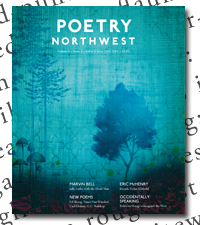
Poetry Northwest was founded as a quarterly, poetry-only journal in 1959 by Errol Pritchard, with Carolyn Kizer, Richard Hugo, and Nelson Bentley as co-editors. The first issue was 28 pages and included the work of Philip Larkin, James Wright, and William Stafford.
Poetry Northwest soon gained an international reputation for publishing some of the best poetry by established and up-and-coming poets in the U.S, Canada, Britain, and beyond, including such notables and award winners as Stanley Kunitz, Thom Gunn, Phillip Larkin, May Swenson, Theodore Roethke, Hayden Carruth, W.S. Merwin, John Berryman, Czeslaw Milosz, Philip Levine, and Anne Sexton.
In 1963, Poetry Northwest became a publication of the University of Washington. In 1964, Carolyn Kizer became the sole editor of the magazine, and held that post until 1966, when she resigned to become the Literature Director at the National Endowment for the Arts. David Wagoner then assumed the role of editor, a position he held for 36 years.
During Wagoner’s tenure, the magazine continued to publish established poets alongside new and emerging writers. Writers such as Harold Pinter, Joyce Carol Oates, Annie Dillard, Raymond Carver, James Welch, Ted Kooser, James Dickey, Robert Pinsky, Richard Wilbur, Wendell Berry, Charles Baxter, Mary Oliver, Edward Hirsch, Stanley Plumly, Linda Pastan, Stephen Dobyns, Stephen Dunn, Jorie Graham, Michael Harper, and Mark Strand were among the major contributors to its poetry-only pages.
In 2002, after several years of dire financial circumstances, Poetry Northwest — at the time one of the longest-running poetry-only publications in the country — temporarily ceased publication.
since 2005
In August 2005, the University of Washington appointed David Biespiel the new editor of Poetry Northwest, with an agreement that the editorial offices of the magazine would relocate to the Attic Writers’ Workshop in Portland, Oregon. The new series resumed publication in March 2006, in a larger, trade magazine format, appearing biannully as a print edition, with new monthly features published online. The magazine was incorporated as a 501(c)3 nonprofit in March 2007. Circulation quickly rebounded, surpassing pre-2000 levels as dedicated readers rediscovered an old favorite, and new readers enbraced the innovative new format.
In January 2010, the Board of Directors appointed Kevin Craft the fifth editor of Poetry Northwest. Craft returned the editorial offices to the greater Seattle area, reaching an agreement with Everett Community College to house and publish to magazine at Everett, where it will play in integral role in EvCC’s Written Arts AFA Program. Even so, Poetry Northwest remains an independent, autonomous nonprofit organization dependent on subscriber and community support.
According to Craft, “Our mission remains what it has been for more than five decades. In the words of founding editor Carolyn Kizer, ‘We shall continue to encourage the young and the inexperienced, the neglected mature, and the rough major talents and the fragile minor ones.’ We remain as committed as we were in 1959 to publishing the best poetry we can find, and to expanding the role and scope of poetry in ways both public and private, innovative and traditional, as an art and as a clear and necessary dialogue in a world overrun with noise.”
 My poem “Letter to My Son Concerning Our First Night of Birthing Class” is included in Linebreak’s fascinating new project, Two Weeks: A Digital Anthology of Contemporary Poetry. You can buy the book (and listen to a reading of my poem!) via the link above.


 I’ve got another review, of Maureen N. McClane’s book of poems