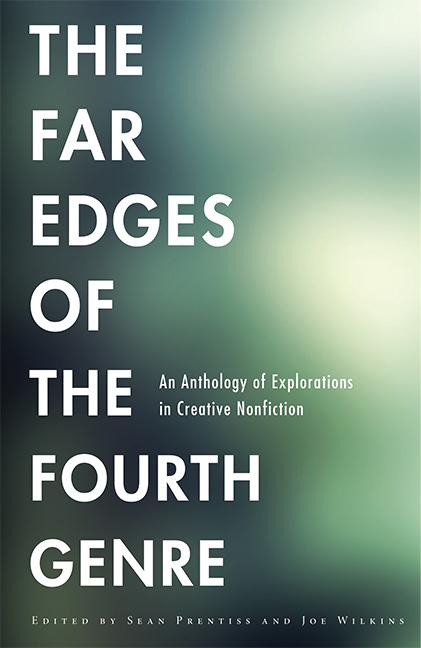
 Co-editor Sean Prentiss and I talked with Hippocampus Magazine recently about our craft anthology The Far Edges of the Fourth Genre. My favorite note: interviewer Lori Meyers calls The Far Edges “a must-read for any writer who wishes to delve further into this curious craft.”
Author: joe.robert.wilkins
Interview at Brevity

Here I am over at the Brevity blog, talking creative nonfiction. Also, make sure to check out Jon Rovner’s stunner of an essay “Refresh,” an example of the great stuff you’ll find in The Far Edges of the Fourth Genre.
Interview with Sean Prentiss up at Brevity
Here’s my co-editor, Sean Prentiss, saying wise things about creative nonfiction and The Far Edges of the Fourth Genre at Brevity!
BLP’s Poem-A-Day
 Black Lawrence Press is featuring a poem-a-day from their impressive catalogue of poets during April. Today, a short bit from my forthcoming BLP chapbook, “Far Enough: A Western in Fragments”:
Read This – Jesmyn Ward’s Men We Reaped

Last week, in my course this semester on rural America in contemporary literature, we started reading Jesmyn Ward’s memoir, Men We Reaped. We’d read a novel and a book of short fiction previously, Kent Haruf’s Plainsong and Bonnie Jo Campbell’s American Salvage, respectively, and I have to admit I was anxious about the move to nonfiction, fearing my students might not fully appreciate the difference, might not understand Ward is telling a given story, rather than creating a story. I was worried the class might leap to judgement before trying out understanding, might be confused by and even afraid of a culture most of them do not share.
I was straight wrong. My students handled the transition with wisdom and care. They articulated to each other the fundamental differences between the project of a memoir and the project of a novel or collection of short fiction; they talked and wondered and built metaphors of understanding. It was the kind of thoughtful, probing, compassionate discussion that almost makes you want to weep for how brilliant your students are, and how special a place the college classroom really is.
But I have to thank Jesmyn Ward, too. She’s written the finest investigation of race, violence, masculinity, and rural poverty I’ve ever read. The achronological, back-and-forth structure; the sharp, angry voice; the clarity of observation and investigation–this is simply a necessary American memoir. Steel yourself for a heart-rending, hard-hitting story, and go read it now.
Video from the William Stafford Celebration at Linfield College
A little late with this, but here’s a video of me reading a Stafford poem and one of my own at the William Stafford Centennial Celebration here at Linfield from this January.
2014 Terroir Creative Writing Festival
 Been a real joy to join, and be so embraced by, the writing community here at Linfield, in McMinnville, and across Oregon and the Pacific Northwest. And I’m really delighted to be part of the 5th Annual Terroir Creative Writing Festival this year. I’ll be teaching a craft class, Notes Toward Evocative Prose: What We Really Mean to Say, and doing a poetry reading with Maggie Chula, Paulann Petersen, and my wonderful colleague Lex Runciman.
AWP
I’m headed to Seattle soon, where I’m jazzed to check out lots of readings and panels, buy lots of books, and sign a few books and talk about landscape myself. Here’s the official schedule:
| Thursday, February 27, 2014 |
|
|---|---|
1:00 pm to 2:00 pm |
|
| Spot: 502 | Author Signing: Wilkins, Joe Organization Name: Fugue Literary Journal / Idaho MFA |
2:00 pm to 3:00 pm |
|
| Spot: 1201 | Author Signing: Wilkins, Joe Organization Name: Michigan State University Press |
| Friday, February 28, 2014 |
|
11:00 am to 12:00 pm |
|
| Spot: Q21 | Author Signing: Wilkins, Joe Organization Name: Terrain Publishing |
| Saturday, March 1, 2014 |
|
12:00 pm to 1:15 pm |
|
| Willow Room, Sheraton Seattle, 2nd Floor | S169. Pacific Northwest Authors Speak About Their Landscape . (Kim Barnes, Bharti Kirchner, Joe Wilkins, William Dietrich, Claire Davis) How important is geography when pursuing literary work, be it poetry, fiction, or nonfiction? Accomplished Pacific Northwest authors who are known to derive inspiration from their scenic land will answer that question. This diverse group will read short selections to illustrate how the setting, combined with imagination, memory, and personal interpretation, plays a large role in their stories. To be followed by a moderated discussion detailing tips and techniques that can make the landscape come alive on your pages.
|
Erik Reece’s Essay from The Far Edges

The Far Edges of the Fourth Genre: An Anthology of Explorations in Creative Nonfiction doesn’t hit stores for a month–but you can get a sneak peak at one of the essays inside today over Terrain.org, where Erik Reece’s “The Act of Writing: Speak and Bear Witness,” a powerhouse craft essay about mountain top mining removal, gonzo poet/journalist techniques, and the moral necessity of getting it right in creative nonfiction, is now live!
Two Poems at Terrain.org
 Couldn’t be happier to have two poems featured today at Terrain.org, one of the finest environmental magazines out there. Big thanks to Simmons Buntin, Derek Sheffield, and the rest of the Terrain crew!


