 I recently spoke with Stephen W. Long, author of the novel There’s a Somewhere, about writing, teaching, and the power of literature; you can listen in here.
Month: January 2014
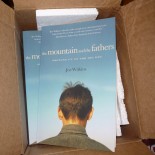
The Mountain and the Fathers Wins 2014 GLCA New Writers Award
Really pleased (read: damned ecstatic) to announce The Mountain and the Fathers has won the 2014 GLCA New Writers Award in Nonfiction. The New Writers Award brings winning writers to GLCA campuses for readings and class visits and has previously recognized the likes of Louise Erdrich, Alice Munro, Richard Ford, Kim Addonizio, Andrew Hudgins, Elizabeth Rosner, Ander Monson, Mary Szybist, and Alan Heathcock, among many others.
Here’s the citation from the judges, which has me blushing and feeling really good about things:
The 2014 winner for creative non-fiction is Joe Wilkins, The Mountain and the Fathers: Growing up on the Big Dry, published by Counterpoint Press. Our judges note:
The Big Dry of eastern Montana makes for a subject of rich complexity. Joe Wilkins evokes place like Willa Cather. That is, place begins as a kind of raw, wide-open poetry. But Wilkins tells a different story. This is about the author’s search for a model of fatherhood, to fill spaces left empty by the death of his father. Wilkins strikes with staggering, melancholy, progressively self-reflective prose that, in part, inhabits the sparseness of the part of Montana where he was born and grew up. Yet his prose also pushes against what might be considered the standard fare of writing fixed in the American West. He addresses memory and the inability to remember in lyrical prose that is, at times, achingly beautiful yet never pretentious or sentimental and never cold. With exquisite control at both the structural and sentence level, he displays both a surety and openness to question, particularly with regard to class and masculinity without theorizing or naming them as such.
Read This – Amy Leach’s Things That Are
 “Come and miss the boat with me,” invites Amy Leach, in “Donkey Derby,” the delightful prologue to Things That Are, her book of science and nature essays. “Come and play some guessing games. We’ll read aloud the illegible electric green script of the northern lights; we’ll speculate about which star in the next ten thousand years is going to go supernova. […] I’ll buy you the rain, you buy me snow, and we’ll go in together for sunshine for the grass and the clover and the delicious prickly thistles.” And even with these first few lines, you begin to see it. Things That Are is like nothing you’ve ever read: the Seussian language and syntax, the quirky, careful observations, and the wild, myriad subjects themselves—goats, peas, panda bears, colliding galaxies, God, global climate change, and oracles—it all combines to create a tone that is fun, funny, and whimsical, as well as serious, reverent, wise, and suffused with grace.
I started dog-earing pages and quit, because I found myself turning back every corner, top and bottom, left and right. Besides, you can simply open Things That Are to any old page and find a line that’ll shock you right back into the real world, the world of silly lilies and stars. For instance, from page 166, this:
Perhaps you have noticed, when you take your wind chimes down to polish them, that the wind does not stop blowing, or that when you put your flute away you do not stop breathing. The wind does not need wind chimes to blow, nor does a person require a flute to breathe; the oracles were not speaking from their own understanding but transmitting the Earth’s emanations. They were mediums, exhilarated intermediaries—the middlewomen gone, the Earth itself may be our authority.
See what I mean? Go miss the boat with Amy Leach. It’s quite a ride.
Nonfiction Editor at High Desert Journal
 I’m excited to announce that I’m joining Charles Finn and the editorial team at High Desert Journal as Nonfiction Editor. HDJ is a semi-annual journal of literary and visual art from and about the American West and in past issues has published a veritable who’s who of contemporary western writers, including William Kittredge, Kim Barnes, Rick Bass, Craig Childs, Amy Irvine, John Daniel, Charles Goodrich, David James Duncan, Kim Stafford, Melissa Mylchreest, Brandon R. Schrand, Maya Jewell Zeller, Mary Sojourner, Russell Rowland, and Robert Wrigley, among many, many others.
Though I’m mostly just excited to get reading, I’m especially interested in narrative and lyric essays that challenge our usual notions (whether historical, political, geographic, or what have you) of the West, as well as work that addresses poverty, race, ethnicity, gender, and sexuality. So if you’ve got something that might fit, send it my way!
 joewilkins.org